Last fall, my grandson started working with me with the intent of taking over my Pest Control Business ( https://www.nfpestcont.com/ ) OK, that's the commercial for this blog post. Anyway, we were out doing jobs on Monday and just finishing up when I got a call from the caretaker at a local Senior Housing project where I have done work in the past (Usually trapping and removing the raccoons with their young getting into the dumpsters in the May/June time frame! Anyway, I told the guy we'd be there shortly. Seems one of the residents had a bird in her wall and the caretaker couldn't figure out how it got into it. We arrive and go to the unit. Sure enough, coming from the wall at the head of her bed was a "chirp", "chirp", "chirp" sound. The exact sound a bird would make! The woman said she'd been hearing it on and off since early last winter, so the bird would have to be able to get in and out or it would have been dead long ago! Stepped outside to check the roof line looking for any hole where the bird might get in and didn't really see much. There was one spot, but that was a long shot. Didn't hear any chirping either. Went back inside. There was the sound again! Went into the adjoining unit and heard nothing. Now, if a bird was in the wall, wouldn't you think you'd hear it from both sides of the wall?
Went back into the offending unit and started looking around. My grandson got down on his knees (I have trouble doing that any more), and put his head under the little table that was being used as a night stand. He said the noise was pretty loud under there, so could it be a cricket under the dresser that was right next to the night stand? Pulled out the dresser. Nothing! Pulled out the drawers. Still nothing! So I decided to pull out the drawer in the night stand and the sound got a lot louder. All three of us almost simultaneously saw the problem and said "hearing aids". The woman had put her hearing aids in a little bowl in the drawer without turning them off, and the noise was the hearing aids getting feedback from each other. Problem solved! So even though we deal with "critters", it isn't always "critters" causing the problem!
Wednesday, May 2, 2018

Wednesday, January 17, 2018
Just Trying to Get a Good Night's (Day's) Sleep!
Last Thursday I got a call from a woman who told me she had a possum in her garage. I informed her I wouldn't be able to make it to her house until the next day. She was fine with that. I told her she might try leaving a trail of dog or cat food out the open garage door and then go shut the door when she went to bed. The possum should have left by then for it's evening foraging. She called me back later, and said she chickened out and didn't want to go into the garage.
When I showed up the next morning, I found two garage doors with a regular door next to them with passage into the garage and stairs up to the house. I went in through the regular door and checked under the stairs and there was the possum looking at me. "Piece of cake" I thought, and went to get my heavy gloves and hoop pole. I came back in, went under the stairs, and the possum is gone! So I start the search. Looking everywhere. I came to the guys workbench and pulled out a box of rags that had been rounded out in the center and rags plied up around that center area for a nice little bed. Not many possums have that kind of 5 star hotel to sleep in.
I continued the search, and couldn't find him anywhere. I was about to give up when I saw him under a dresser that was in the garage. I poked around under there to get him to move, because I couldn't get him with the hoop pole under there. Finally, he moved and disappeared again! Now where the hell was he? I went back to the workbench, and saw the tail sticking out of the box of rags. He got tired of my BS and went back to bed! I grabbed his tail, pulled the box out a little and got him behind the head with my other hand and carried him out the door. Of course, the husband had to take the obligatory photo of me holding him before I let him go. The photo must have been good because he (the possum) had his mouth open, looking all vicious! He was a little undersized so I assumed he was one that had been born last spring, and hadn't quite reached full adult size yet. I let him go at the side of the garage and he ran around the corner of the house and through the lattice work surrounding their deck. Told them he would be fine under there. Wouldn't cause any problem..
When I showed up the next morning, I found two garage doors with a regular door next to them with passage into the garage and stairs up to the house. I went in through the regular door and checked under the stairs and there was the possum looking at me. "Piece of cake" I thought, and went to get my heavy gloves and hoop pole. I came back in, went under the stairs, and the possum is gone! So I start the search. Looking everywhere. I came to the guys workbench and pulled out a box of rags that had been rounded out in the center and rags plied up around that center area for a nice little bed. Not many possums have that kind of 5 star hotel to sleep in.
I continued the search, and couldn't find him anywhere. I was about to give up when I saw him under a dresser that was in the garage. I poked around under there to get him to move, because I couldn't get him with the hoop pole under there. Finally, he moved and disappeared again! Now where the hell was he? I went back to the workbench, and saw the tail sticking out of the box of rags. He got tired of my BS and went back to bed! I grabbed his tail, pulled the box out a little and got him behind the head with my other hand and carried him out the door. Of course, the husband had to take the obligatory photo of me holding him before I let him go. The photo must have been good because he (the possum) had his mouth open, looking all vicious! He was a little undersized so I assumed he was one that had been born last spring, and hadn't quite reached full adult size yet. I let him go at the side of the garage and he ran around the corner of the house and through the lattice work surrounding their deck. Told them he would be fine under there. Wouldn't cause any problem..
Sunday, June 11, 2017
Woodstove Noises
Got a call from a customer who was hearing noises in his wood stove. Now in the past I have taken gray, and flying squirrels, bats, and birds out of wood stoves. So I figured it had to be one of them. So I hop in my truck, and drive over to his house. Get there, and open the stove door a crack and don't see anything. Close it back up and hear a noise in the stove pipe coming off the back of the stove. Bang on the pipe a little, and open the door a crack again. There it is clinging to the back of the stove (see picture). Reach in slowly and carefully and grab it. Pull it out of the stove and walk out onto the deck to release it, figuring I'm done with this job, and let it go. It flies away with no problem. Just then I hear the wife say "I hear another one". Sure enough, there's another one in there! Open the door, and this time there's one hanging on the inside of the door, So I repeat the process, and this one flies away OK. Think that was the end of it? Nope! There was a THIRD one in there. All three released with no problem. Chimney swifts build mud nests on the inside surfaces of chimneys. My guess is that this nest broke off the chimney and fell down into the wood stove pipe near the stove just as they were fledging (leaving the nets for good) and they couldn't get back up the chimney. These were probably just fledged. and got stuck in the stove. It had a happy ending for all concerned. Chimney swifts are declining in general over most of their range.
Here is a link to CT DEEP's web page about them.
CT DEEP/Chimney swifts
Here is a link to CT DEEP's web page about them.
CT DEEP/Chimney swifts
 | |
|
 |
| Swift in hand, outside, ready to be released. |
Thursday, October 22, 2015
Back hurts?
A couple of weeks ago, I did a flying squirrel job in Bethlehem. I set
up a one way door trap at the obvious entry point (hole chewed in the
soffit of the roof). The guy called me the next morning to inform me
that I had 4 or 5 in the trap (It actually turned out to be 7). Flying
squirrels are nocturnal, so they are always caught overnight. Drove up
there, swapped out the trap, and brought them home to release in my back
yard. I let them go by opening the trap, and putting it against a tree
trunk and they run out and up the tree. Well, 6 of them left and
scampered up the tree, but the seventh one came out and just sat there,
so my wife decided to see how close she could get. I guess it's back hurt and decided to stick around and see if someone would give it a back rub!
Video:
Flying squirrel back rub!
P.S. That's our yellow lab, "Moo" barking in the background. Jealous, I guess!
 |
| This is what the little guy looked like |
Video:
Flying squirrel back rub!
P.S. That's our yellow lab, "Moo" barking in the background. Jealous, I guess!
Saturday, September 26, 2015
Biggest? and Stangest?
 |
| Biggest? |
This next one is really strange.
Apparently they didn't have much faith in their
engineering department. They built this one inside a street light (privately owned), near a
customers house, so they would have some extra protection from the
weather. Normally these nests can hold up to anything up to and
including a Category 2 hurricane. I didn't kill this one because I had been called to the house for a yellow jacket nest in the wall and one of the woman's kids showed me this one. It was so high up it wouldn't bother anyone. So I let it be, they have their place in the environment and are beneficial as long as they don't bother people. I told her kids not to throw rocks at it!
 |
| Strangest? |
Sunday, September 6, 2015
Can an ugly reptile be cute?
I think they can, especially when you see this! I went to a mouse/carpenter ant job the other day, and after I finished, I was standing in the customer's driveway talking to him, when we saw this on his driveway.
A little background here. He has a pond out in back of his house, and he tells me that every June, a big female snapping turtle comes up on his lawn and tears it all up digging a hole to lay her eggs.
Well, the summer is almost over, and I guess the eggs have hatched, because this is what was in his driveway. That's a quarter next to it for a size comparison. That's how big a newly hatched snapping turtle is, and I guess we have all seen what they grow up to be. Those 40 pound, 18" long monsters you never want to deal with! A few minutes later, the customer found another one a few feet away on his lawn. When I left he was headed for the pond to release the little guys!

A little background here. He has a pond out in back of his house, and he tells me that every June, a big female snapping turtle comes up on his lawn and tears it all up digging a hole to lay her eggs.
Well, the summer is almost over, and I guess the eggs have hatched, because this is what was in his driveway. That's a quarter next to it for a size comparison. That's how big a newly hatched snapping turtle is, and I guess we have all seen what they grow up to be. Those 40 pound, 18" long monsters you never want to deal with! A few minutes later, the customer found another one a few feet away on his lawn. When I left he was headed for the pond to release the little guys!

Sunday, August 23, 2015
Ever wondered what was inside...............................?
Well, here is the answer! I went to do a bald faced hornet job in
Roxbury yesterday. It was attached to the side of a window air
conditioner and to the window itself. It was a pretty good sized nest,
that had been started in mid-May. It was good and healthy, and very busy. The woman decided to kill it because she was starting to get some in her bedroom even though she had taped the window up pretty good. These are not pollinating "bees", they are carnivorous, feeding on caterpillars and other insects. They are not in any trouble like the pollinating bees are, and can be very dangerous. They have their place in the environment, but when they are just above a deck on someone's home they have to be removed. If they were 25' up on a tree branch, I would recommend just letting them be.
 |
| This is what the nest looked like from outside. |
Took the video from inside the bedroom window. I have only seen this once before in my entire life and that was when I was a kid! The woman called it her science project. Her daughter and grandchildren had come up from New York. Boy, did they have a good time taking pictures and videos. Talk about "Show and Tell" for school which is starting soon!
Thursday, August 6, 2015
The Interesting Jobs Just Keep Coming
Yesterday I went to Seymour for a "fluttering and squeaking" mysterious noise in the chimney of a fireplace. That covers a lot of territory. Could be just about anything. Got to the house, opened the screen of the fireplace, opened the damper, and got into a position where I could look up the chimney. I saw the problem immediately. Only saw it once before in twenty years in the business. Nothing needs to be done, the problem will resolve itself shortly. The cause of the noise was "chimney swifts". These are small swallow like birds that build mud nests on the inside of chimneys. There they lay eggs, raise their young, and when the young fledge (leave the nest), they are done for that season. They will come back year after year unless the chimney is capped, but they do no harm, so why not provide them a happy home, and help out a species that is in decline, especially in CT.
This is a photo I took, looking up the chimney. You can see three young, just fledged, swifts hanging on the side of the chimney. Just above and to the left of them is the edge of their nest, attached to the side of the chimney.

Here is link to more info on Swifts!
http://www.allaboutbirds.org/guide/Chimney_Swift/id
This is a photo I took, looking up the chimney. You can see three young, just fledged, swifts hanging on the side of the chimney. Just above and to the left of them is the edge of their nest, attached to the side of the chimney.

Here is link to more info on Swifts!
http://www.allaboutbirds.org/guide/Chimney_Swift/id
Sunday, August 2, 2015
Illegal Immigrants? (title - courtesy of my wife)
I did a yellow jacket job this morning, and ran across something I've only encountered about 4-5 times in my 20 years of doing pest control. This is the nest I removed from a barn at a horse farm.
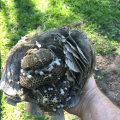 Pretty routine, except it was in a difficult spot, and required some gymnastics to get at it! What came as a surprise was what was inside it.
 Yep, a black and white yellow jacket. The common yellow jacket is the upper one. My understanding is that these black and white ones are parasitic. Their queens, instead of starting their own nests in the spring, wait around until the common yellow jackets get their nests started and then they move in, kill the existing queen, and proceed to start laying eggs. Over the course of the summer, the workers gradually shift from yellow and black to white and black as the existing jackets die, and new black and white ones emerge from the eggs laid by the new queen.
Nothing really different with this. They are still dangerous and should be removed, unless they are well away from humans. Just one of those curiosities that nature is always throwing at us!


Nothing really different with this. They are still dangerous and should be removed, unless they are well away from humans. Just one of those curiosities that nature is always throwing at us!
Friday, July 31, 2015
Poor Little Guy
Had an interesting job yesterday. A regular customer had a little shed outside that he kept his garbage pails in. Something was digging underneath to get inside. I looked at it the other day and couldn't tell right away whether something was digging in to get the garbage, or was living under the shed. Called the customer (who was in California on vacation) and told him we could put exclusion fencing around the shed, to prevent further problems, and leave one spot open, so we could put a trap there and catch the culprit. The hole appeared too small to be from a raccoon or woodchuck, but there was no skunk odor around either. This was really puzzling.
Got there this morning and saw that the hole was still there, and was still about the same size. Opened the shed and began to look around. All the garbage had been picked up, and all the pails were empty. Looked in one, and then grabbed the side of the second one. Peeked inside. There in the bottom was an adult skunk, sitting in the bottom. Surprised me a little, but once I composed myself, I carried the pail to the edge of his lawn and released the skunk. Neither it nor I were any worse for the wear, but I have no idea how long it was in there, but it wasn't there the other day when I checked. Apparently, it fell in looking for food and couldn't get out.
Finished up by putting in the fencing. No need to set a trap. The culprit got caught in the garbage pail. Another successful job completed.
Got there this morning and saw that the hole was still there, and was still about the same size. Opened the shed and began to look around. All the garbage had been picked up, and all the pails were empty. Looked in one, and then grabbed the side of the second one. Peeked inside. There in the bottom was an adult skunk, sitting in the bottom. Surprised me a little, but once I composed myself, I carried the pail to the edge of his lawn and released the skunk. Neither it nor I were any worse for the wear, but I have no idea how long it was in there, but it wasn't there the other day when I checked. Apparently, it fell in looking for food and couldn't get out.
Finished up by putting in the fencing. No need to set a trap. The culprit got caught in the garbage pail. Another successful job completed.
Wednesday, July 15, 2015
OMG, Is it going to sting me?
"Bees"! Just the word can strike fear in some people's hearts, but did you know that the majority of "bees" are not dangerous at all! Now that we are in the peak of "bee" season, I thought I would write something to help people understand. I will put some videos and pictures at the end of this post for anyone to watch.
There are basically two categories of "bees". Members of the wasp family and true bees. And within each of these groups there are "Social bees" and "solitary bees". True bees, in CT are made up up of honey bees, bumblebees, carpenter bees, and ground bees. Social bees are ones that build hives which contain dozens (bumblebees) to tens of thousands (honey bees). Both of these will sting, if provoked, but are usually not very aggressive. Solitary bees are carpenter bees and ground bees. While there may be many solitary bees around in a certain area, each one is an individual, and they do not make up a "hive". The reason there are so many there is because the habitat is good for them. Solitary bees, while capable of stinging rarely ever do. The reason is that because if they sting, they are likely to die, and therefore cannot pass on their genes or DNA to the next generation. Social bees can be somewhat more aggressive because if they sting and then die, the hive lives on and it's genes are passed on. They give their life to protect the hive. While ground bees may look terrifying, you can actually walk right into them and you won't be stung!
The same groupings can be done with wasps. Solitary wasps like the Mud dauber (These build little mud tubes and feed mostly on spiders) and the many species (all uncommon) of "digger" wasps (you'll find these between the pieces of flagstone on your patio) are totally harmless and will not sting and are very beneficial. Paper wasps build those little gray paper nests that are not enclosed and in which the comb can be seen. These are semi aggressive. If they are close to a door, or an area where there is a lot of human activity, they can present a problem, but up at the roof line where they typically are, they are no problem. Yellow jackets (don't confuse these with Mediterranean wasps- a lot of people do) and Bald Face Hornets are truly dangerous insects. Stumble into one of their nests, and they will attack in multiple numbers and each one can sting repeatedly. Many people find these (yellow jackets in the ground) with their lawn mower or weed wacker, so be careful out there. So basically there are really only three "bees" that will possibly sting you. Paper wasps, yellow jackets, and Bald faced hornets. So if there are others around just ignore them and they won't bother you.
o . . |
| Common paper wasp |
 |
| Bumblebee |
 |
| Honey bee |
 |
| Yellow jacket |
 |
| Bald faced hornet |
 |
| Mediterranean Paper wasp |
 |
| Carpenter bee |
 |
| Mud Dauber wasp |
Carpenter bee infestation
Active honey bee hive(These are usually found in the structure of buildings or hollow trees)
Aerial yellow jacket nest (Bald faced hornets build similar nests)
Yellow jacket nest in the ground
Bumblebee nest in the ground
Ground bees
Bald faced hornet nest
Their season is over, but here's some info for next year
Carpenter bees resemble huge bumble bees, and are excellent pollinators. They are active mostly during the month of May in this part of the country. Unlike most bees, they can hover in one spot like a helicopter. They emerge from winter dormancy in late April. The males and females fly around doing their mating flights. If there are a lot of them present, it can be a terrifying sight to the uninformed. However, the males do not possess a stinger and while the females do, they almost never sting. They are about as harmless as a bee with a stinger can be. Once they mate the males die and the females go about drilling their holes. The holes are typically 1/2” in diameter. They prefer to tunnel into unpainted wood, but will tunnel into painted or stained wood. They will drill into fence posts, any untreated beams in houses, decks, etc.. They also get behind the trim boards along the roof line of a house and drill holes from the back side of these boards. They drill into the wood about half way and then turn at right angles and drill a tunnel 6-8” long. Their activity is usually first noticed by piles of sawdust on a roof under the drilling activity or on the ground or by their fan shaped droppings stains beneath the drilled holes. Once the female lays an egg, she provides it with “bee bread” (a mixture of pollen and nectar). She then seals the egg in a chamber with wood pulp and proceeds to do the same with the next egg, until she has deposited about 6-8 eggs in the tunnel. This can cause quite a problem at times, because woodpeckers can start pecking holes from the outside, looking for the larvae in the tunnels to feed on. After she finishes her egg laying, usually in very early June she dies. This is why the activity is seen mostly in May. The young emerge later in the summer and spend the rest of the season feeding on nectar in flowers. There is only one reproductive cycle per year. The young sometimes return to the tunnels they were born in to spend the winter. Unless there is a serious infestation over several years, the damage is usually just cosmetic. They never tunnel all the way through and get into the house or attic.
The best way to solve the problem, is to replace the boards they are drilling into with a composite decking material. One Brand name is "Azek". They will not drill into that. Another method is to physically exclude them from the areas they drill in by stuffing fencing, steel wool, or some similar material up behind the trim board thereby limiting their ability to get behind the boards.
In the photo, the dropping stains can be seen on the clapboard siding. The holes in the trim board are those made by woodpeckers, looking for the nice juicy larva in the tunnels in the trim board.
The best way to solve the problem, is to replace the boards they are drilling into with a composite decking material. One Brand name is "Azek". They will not drill into that. Another method is to physically exclude them from the areas they drill in by stuffing fencing, steel wool, or some similar material up behind the trim board thereby limiting their ability to get behind the boards.
In the photo, the dropping stains can be seen on the clapboard siding. The holes in the trim board are those made by woodpeckers, looking for the nice juicy larva in the tunnels in the trim board.
 |
| Typical Carpenter bee damage |
Sunday, July 12, 2015
Been gone too long!
Well, it's been awhile since I posted anything ! Life just seems to get in the way. It was always, "Oh, I'll do
that tomorrow", but as the old saying goes, "Tomorrow never comes". So
here I am again, and I hope to be more diligent in posting tips, and
stories, both instructive and funny.
Big doings at North Forty Pest Control. We have now set up a sort of branch office in Bantam, CT, where my stepson, Matt, lives. We work together, and he is now fully licensed, so if you live in the Northwest CT area, and have any pest problems, feel free to give him a call at 860-387-1314, and if you're from the Waterbury area give me a call at 203-263-4551.
So, anyway, it's been a busy season so far, and Yellow jackets and Bald faced hornets are getting started. They seem to be about 2-3 weeks early this year, and with the cold spring we had it is even more confusing. I saw a lot of queens flying around looking for places to start nests back in May. Looks like it's going to be another bad (great for us) season, just like last year! So keep your eyes peeled and watch out with those lawn mowers and weed whackers. That is usually people's favorite way of finding yellow jacket nests in the ground, and usually with some pain involved.
Big doings at North Forty Pest Control. We have now set up a sort of branch office in Bantam, CT, where my stepson, Matt, lives. We work together, and he is now fully licensed, so if you live in the Northwest CT area, and have any pest problems, feel free to give him a call at 860-387-1314, and if you're from the Waterbury area give me a call at 203-263-4551.
So, anyway, it's been a busy season so far, and Yellow jackets and Bald faced hornets are getting started. They seem to be about 2-3 weeks early this year, and with the cold spring we had it is even more confusing. I saw a lot of queens flying around looking for places to start nests back in May. Looks like it's going to be another bad (great for us) season, just like last year! So keep your eyes peeled and watch out with those lawn mowers and weed whackers. That is usually people's favorite way of finding yellow jacket nests in the ground, and usually with some pain involved.
Friday, November 7, 2014
What a summer it was!
Yellow jackets and white faced hornets. We all know about them. Nests in the ground, big gray nests hanging from tree branches, in shrubbery, on the roof line of the house, or yellow jackets getting into the house from nests that are in the structure of your home. Matt (my stepson) and I ran ourselves ragged dealing with these things this summer. It started about mid-July, which is typical. Then it cranked up, and never stopped until about 2 weeks ago. They were everywhere!
One example, we went to check out a BAT job in a neighboring town, and before we left we killed four yellow jacket nests in the guy's house and stonewall that he didn't even know he had. That's how the season went!
I went to one job where a family had a nest on the bottom of their deck, right where they stepped out the kitchen door. Obviously, they couldn't use their deck. The deck was about 3 1/2 feet off the ground, so since I was going to have to go in on hands and knees, I figured I better put on my bee suit (only goes to my waist) and gloves. All dressed, and in I go. Have to crawl about 20 feet, and as get about halfway in, I kneel on an old piece of rotten cardboard. Anyone want to guess what was under the cardboard. Yep, another nest. Panic time!!!. I start getting stung, and I start scrambling out from under the deck, laying down a fog of spray as cover, and finally make it out. Got stung six times, including once on each of my butt cheeks. I let them calm down for a few minutes, and I head back in. Got both nests this time! Ah, revenge is sweet. As I said before it was a record year. I more than doubled my all time record for one season. It was unbelievable!
One example, we went to check out a BAT job in a neighboring town, and before we left we killed four yellow jacket nests in the guy's house and stonewall that he didn't even know he had. That's how the season went!
I went to one job where a family had a nest on the bottom of their deck, right where they stepped out the kitchen door. Obviously, they couldn't use their deck. The deck was about 3 1/2 feet off the ground, so since I was going to have to go in on hands and knees, I figured I better put on my bee suit (only goes to my waist) and gloves. All dressed, and in I go. Have to crawl about 20 feet, and as get about halfway in, I kneel on an old piece of rotten cardboard. Anyone want to guess what was under the cardboard. Yep, another nest. Panic time!!!. I start getting stung, and I start scrambling out from under the deck, laying down a fog of spray as cover, and finally make it out. Got stung six times, including once on each of my butt cheeks. I let them calm down for a few minutes, and I head back in. Got both nests this time! Ah, revenge is sweet. As I said before it was a record year. I more than doubled my all time record for one season. It was unbelievable!
 | |||||||||||||||||||||||||||||||||||||||||||||||||||||||||||||||||||||||||||||||||||||||||||||||||||||||||||||||||||||||||||||||||||||||||||
Yellow Jacket or Hornet nest
|
 |
| Yellow Jacket |
 |
| White Faced Hornet |
Sunday, May 11, 2014
Check for Potential Hitchhikers
The end of the college year is near and students will be coming home with all their "stuff". Are you prepared to deal with any potential hitchhikers in that stuff? I'm referring to bed bugs and cockroaches! College dorms and off campus apartments are sometimes notorious for having infestations of those two nasty insects.
When your student arrives home, go through ALL of the stuff they brought home. Go through it with a "fine tooth comb", BEFORE you bring anything into the house. Check all clothing , drawers of any furniture, books (especially inside book jackets), etc. These insects are masters at hiding and you don't want to bring any into the house, or in a few weeks you will calling someone like me to get rid of them. Stop them before they get in your home. I have posted pictures of both so you know what you are looking for.
When your student arrives home, go through ALL of the stuff they brought home. Go through it with a "fine tooth comb", BEFORE you bring anything into the house. Check all clothing , drawers of any furniture, books (especially inside book jackets), etc. These insects are masters at hiding and you don't want to bring any into the house, or in a few weeks you will calling someone like me to get rid of them. Stop them before they get in your home. I have posted pictures of both so you know what you are looking for.


 | |
| German cockroaches ( top row, l to r - adult roach, female carrying egg sac, and final stage nymph, bottom row, l to r - egg sac, various nymph stages) |
 | ||||||||
| Adult bed bug (they are about the size of an apple seed). Young bed bugs are the same shape, but smaller than adults. |
Monday, September 23, 2013
New College Graduate?
Yellow jackets and White faced Hornets are usually amazing engineers. Those large gray paper nests they build will stand up to just about anything. They start the nests in mid-May and they just get larger and more populous as the summer goes along. You would think that being made of paper, a good heavy thunderstorm would wipe them out, but the rain just runs right off them. Occasionally, you'll see one built in a location that makes you wonder if they have lost faith in their Engineering Dept. Maybe it's a new college graduate in charge, and they figure they need some extra protection, just in case, so they built their home here!


Bat Exclusion Season
Soon (3 or 4 weeks from now), bats will be leaving their summer roosts (your attics, louvers, shutters, or soffits) for their winter hibernation. Relax, not everyone has bats! Bat exclusion can then be done without worrying about having to get the bats out first (98% of the time that is true). On a rare occasion, you may get one macho male bat who thinks he can overwinter in his summer roost. Those that attempt that normally die over the winter. Once bats leave, we can go over the house and close up any possible entry points, so when the bats return in the spring, they can't get back in. It is much less expensive doing it this way, than having to gets the bats out first.
Yesterday, we did a job in Roxbury, where the customer had bat droppings accumulating on the patio under the louvers (the slatted vents for the attic) of his house. We put up the ladder, climbed up, and checked. Didn't know if the bats were living in the louvers, or the louver screening had failed and they were in the attic. No bats in that one, screening was intact, so we sprayed the live wasp nest we found, removed all the old wasp nests, and covered the louver with hardware cloth. Now to the other end of the house, put up the ladder, and along with the wasp nests, were two Big Brown bats hanging on the screen under the louver slats. Screening on that one was intact, too. It was a little chilly, so the bats were a little lethargic. When I shooed them out, they didn't fly, they just opened their wings, and kind of parachuted to the ground. We picked them up with gloved hands, put them on a stone wall in the sun, and a few minutes later they had warmed up to the point where they flew off, but in the meantime, I got these photos.
Went back up the ladder, cleaned out the wasp nests, and installed hardware cloth. Another successful job!


Yesterday, we did a job in Roxbury, where the customer had bat droppings accumulating on the patio under the louvers (the slatted vents for the attic) of his house. We put up the ladder, climbed up, and checked. Didn't know if the bats were living in the louvers, or the louver screening had failed and they were in the attic. No bats in that one, screening was intact, so we sprayed the live wasp nest we found, removed all the old wasp nests, and covered the louver with hardware cloth. Now to the other end of the house, put up the ladder, and along with the wasp nests, were two Big Brown bats hanging on the screen under the louver slats. Screening on that one was intact, too. It was a little chilly, so the bats were a little lethargic. When I shooed them out, they didn't fly, they just opened their wings, and kind of parachuted to the ground. We picked them up with gloved hands, put them on a stone wall in the sun, and a few minutes later they had warmed up to the point where they flew off, but in the meantime, I got these photos.
Went back up the ladder, cleaned out the wasp nests, and installed hardware cloth. Another successful job!


Sunday, July 21, 2013
All the Comforts of Home, in this Heat!
My stepson (Matt) and I went to Roxbury yesterday to check out a house that was having a "Mysterious noises in the attic" issue. Could be raccoons, mice, flying squirrels, or gray or red squirrels. As we inspected the house, the home owner showed us a picture of a raccoon that another Pest Control company had trapped, several weeks ago, on the roof, right where it had been getting into the attic. OK, that eliminates raccoons!
We found several possible spots where critters could be accessing the attic. We decided to go in the house and check out attics, or at least Matt could. I'm getting too old for that, especially in this heat. There were several different parts of the attic to check. Matt went into a couple, didn't stay very long, because of the heat, came back down, and said that there was a lot of mouse and flying squirrel droppings. He then headed for the last attic to be checked. The one near where the raccoon had been captured. Up he went, and shortly he was back down, with a smile on his face. I asked him what he was smiling about, and he said that the raccoon had ripped a hole in an air conditioning duct right next to where it's nest was. Apparently, it was getting too hot up there even for him, so he decided to get some AC for his nest. You won't find many animals smarter than a raccoon.
We found several possible spots where critters could be accessing the attic. We decided to go in the house and check out attics, or at least Matt could. I'm getting too old for that, especially in this heat. There were several different parts of the attic to check. Matt went into a couple, didn't stay very long, because of the heat, came back down, and said that there was a lot of mouse and flying squirrel droppings. He then headed for the last attic to be checked. The one near where the raccoon had been captured. Up he went, and shortly he was back down, with a smile on his face. I asked him what he was smiling about, and he said that the raccoon had ripped a hole in an air conditioning duct right next to where it's nest was. Apparently, it was getting too hot up there even for him, so he decided to get some AC for his nest. You won't find many animals smarter than a raccoon.
Thursday, July 4, 2013
It's Snake Season!
SNAKES! Oh, the horror! The phobia a lot of people have about snakes probably goes back to the serpent in the Garden of Eden. They are not anything to fear. Despite what a lot of people think, snakes are not slimy, they are very dry to the touch.
I have been getting snake calls for a couple of weeks now, and there is really not a lot that can be done to get rid of them. There is really no way to "bait" or trap them. They can be removed by carefully picking up by the head, putting in a container, and relocating. Calling someone like us (unless it is in a basement) usually does no good,because by the time we get there the snake will be gone. If you have one in your yard, it's because you have the three things that all living things require-food, shelter, and water. They have probably been around for awhile, but being very secretive, you just never saw them. Snakes are totally harmless, even the venomous ones - the Copperhead and Timber rattlesnake here in CT. They will just lay still until the "threat" is past and will only bite if handled or feel they are cornered. You may have walked past one in the past and never even realized it. Snakes will not chase you, and they will not "attack" you. They just want to be left alone to go about their business. Snakes are extremely beneficial because they eat insects, small rodents, and other small critters. Snakes may occupy an abandoned rodent burrow, but cannot dig holes by themselves. Snakes have their place in nature like all other animals. Please, DO NOT KILL THEM! Below I have posted pictures of the most common snakes in CT, and a little bit about each.
I have shown the copperhead and milk snake side by side because the milk snake is most often mistaken for a copperhead.The copperhead is very uncommon and rarely seen. Note that on the copperhead the dark bands are much wider on the side than on the back, it's overall coppery color, and the head which is much wider than the body. The milk snake's bands are the same size all the way around. If it is seen, it's belly has a blue and white checkerboard pattern. It has a "V" or "Y" mark on the top of it's head, which is only slightly wider than it's body. Milk snakes occupy typical habitat around houses and will occasionally get into a basement.
The Garter snake (not "garden" or "gardener" snake) is arguably the most commonly seen snake in CT. It inhabits lawns, gardens, brush piles, stone walls, etc. Their pattern and coloring can vary greatly, but always consists of a dark gray to blackish color with thee light yellowish colored strips running the length of the body, They can be easily moved along by using a broom or something similar. They do no harm.
The Northern Water Snake is found around slow rivers, lakes, ponds, and swampy areas. It is fairly common and is NOT a Water moccasin(or Cottonmouth). They feed mostly on frogs and fish, but will take a occasional bird, bird egg or rodent. Water moccasins are a southern snake and their range only extends up to southern Virginia. While they can act aggressively, they are totally harmless, and will leave if given the opportunity.
The Ringneck snake likes woody, rocky habitat and are very commonly found in basements. They are grayish black on the back with a yellowish ring around the neck, and a yellowish colored belly. This is a smallish snake with a huge one being two feet long, but most are less than a foot long.
Snakes found in basements can be removed by putting something, like a wastebasket, over them and slowly pushing a piece of cardboard under the wastebasket and then taking it outside and releasing it.
These are probably the four most common species of snakes seen in CT(I am not including the Copperhead, because they are NOT common).
For info on the other 10 species native to CT, go to http://www.nfpestcont.com/Snakes.html
 | ||||||||||||||
| Milk Snake |
 |
| Copperhead |
 | |||||
| Northern Water Snake |
 | ||
| Garter Snake |
 |
| Ringneck Snake |
Thursday, May 9, 2013
Omigod, It Must be Rabid
Another refresher course from a previous post. We've already been doing squirrel and raccoon babies. Skunks are starting to give birth just about now.
Subscribe to:
Posts (Atom)